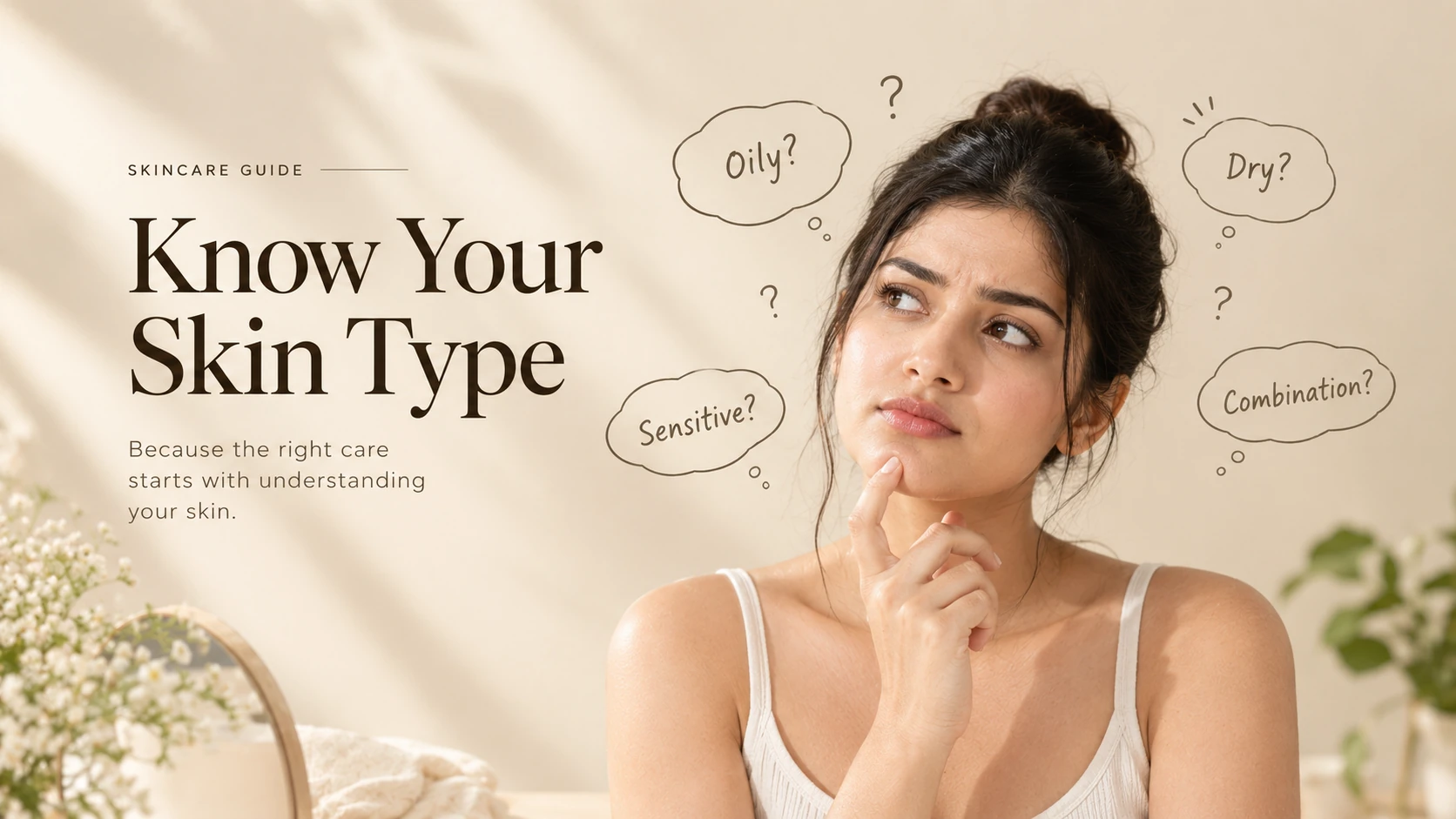
Most skincare doesn't fail because the product is bad. It fails because it was never right for the skin type it was used on. A gel moisturizer that works great for oily skin can leave dry skin feeling tight and flaky. A rich cream that saves dry skin can clog oily skin within days.
Before buying anything new, it helps to actually know your skin type. Not guess, know. This guide walks through simple tests you can do at home, the signs of each skin type, and what to do once you've figured out where you land.
Why Knowing Your Skin Type Matters
Skin type and skin concerns aren't the same thing, even though people mix them up often.
Skin type is the baseline, oily, dry, combination, or sensitive. It's fairly consistent and doesn't change much unless something major shifts, like climate, hormones, or age. Skin concerns are specific issues layered on top, acne, pigmentation, fine lines, dullness. You can have oily skin with pigmentation, or dry skin with sensitivity. Type and concern work together, but they're not interchangeable.
Getting the skin type wrong throws off everything else. A routine built for the wrong type tends to cause more breakouts, more irritation, and a lot of wasted products that never really worked.
How to Know Your Skin Type at Home
You don't need a dermatologist visit to figure this out. Two simple tests, done at home, usually give a clear answer.
The Bare-Face Test
Wash your face with a gentle cleanser and pat it dry. Don't apply anything after, no moisturizer, no serum, nothing. Wait 30 minutes and check how your skin feels and looks.
- Tight, flaky, or uncomfortable: leans dry
- Shiny across the whole face: leans oily
- Shiny only in the forehead, nose, and chin, normal or dry elsewhere: combination
- Red, itchy, or reactive without touching anything new: leans sensitive
The Blotting Sheet Test
Press a blotting paper (or a plain tissue) gently against different areas of your face, forehead, nose, cheeks, and chin. Hold it up to the light afterward.
- Heavy oil across all areas: oily skin
- Little to no oil anywhere: dry skin
- Oil from the T-zone only, none from the cheeks: combination skin
Run both tests, and the pattern usually repeats itself. That repetition is what confirms the type.
Signs of Oily Skin Type
Oily skin is easy to spot once you know what to look for.
- Visible shine, especially by midday, concentrated on the forehead, nose, and chin
- Pores that look larger or more visible than average
- Frequent blackheads, especially around the nose
- Makeup that tends to slide off or look patchy a few hours in
Oily skin does better with lightweight products. A gel-based moisturizer, an oil-free cleanser, and serums built with niacinamide tend to work with oily skin rather than against it. Skipping moisturizer entirely, a common instinct with oily skin, often backfires and triggers even more oil production.
Signs of Dry Skin Type
Dry skin shows up differently, and it's often more noticeable right after cleansing.
- Tightness that shows up within minutes of washing your face
- Flaking, especially around the nose, cheeks, or eyebrows
- Dull texture that doesn't go away even with moisturizer
- Fine lines that look more pronounced due to lack of hydration
Dry skin needs richer formulas across the board. Cream cleansers instead of foaming ones, hydrating serums with hyaluronic acid or ceramides, and a moisturizer with enough weight to actually hold moisture in overnight.
Signs of Sensitive Skin Type
Sensitive skin isn't always about how skin looks. Often it's about how skin reacts.
- Redness or stinging after trying a new product
- Irritation from fragrance, alcohol, or certain active ingredients
- Skin that flushes easily from heat, weather, or even stress
- A pattern of reacting to products that work fine for most people
If this sounds familiar, patch-testing anything new before applying it to your full face is worth the extra step. Fragrance-free, minimal-ingredient formulas tend to be the safest starting point.
Signs of Combination Skin Type
Combination skin is the one that confuses people most, mostly because it doesn't fit neatly into one category.
- Oily T-zone, forehead, nose, and chin, but normal or dry cheeks
- Shine and tightness showing up in different areas on the same day
- Pores that look larger in the center of the face, smaller elsewhere
- Products that work for the T-zone often feel wrong on the cheeks
Combination skin usually needs a zone-specific approach rather than one product doing everything. A lighter gel on the T-zone and a slightly richer cream on the cheeks tends to work better than picking one formula for the whole face.
Common Mistakes When Identifying Skin Type
A few things throw off the results, even when you're doing the tests correctly otherwise.
- Testing right after washing with hot water, which strips natural oils and can make skin look drier than it actually is
- Judging skin type off one bad skin day, weather, stress, and hormones can all temporarily change how skin behaves
- Confusing dehydrated skin with dry skin type, dehydration is a temporary lack of water and can happen to oily skin too, while dry skin type is a longer-term lack of oil production
If the results feel inconsistent, running the test again a day or two later, without any new products in between, usually clears things up.
Frequently Asked Questions
1. Can your skin type change over time?
Yes. Hormones, age, climate, and even stress can shift skin type over the years. Skin that was oily in your twenties can turn drier later on, so it's worth retesting occasionally rather than assuming it stays fixed forever.
2. How often should I retest my skin type?
Once or twice a year is reasonable, or any time your routine suddenly stops working the way it used to. Seasonal changes can also shift how skin behaves, so retesting when the weather changes isn't a bad idea either.
3. Can you have more than one skin type at once?
That's essentially what combination skin is, oily in some areas and normal or dry in others. It's common, not an exception.
4. Is dehydrated skin the same as dry skin type?
No. Dehydrated skin lacks water and can happen to any skin type, including oily skin. Dry skin type lacks oil production and tends to be a more consistent, longer-term trait.
5. What's the fastest way to know your skin type?
The bare-face test is usually quickest. Cleanse, wait 30 minutes, and observe how skin looks and feels without any product on it.
6. Does oily skin still need moisturizer?
Yes. Skipping moisturizer on oily skin often triggers more oil production to compensate. A lightweight, oil-free formula works better than skipping the step entirely.
7. Can sensitive skin also be oily or dry?
Yes. Sensitivity is more about how skin reacts to products than the amount of oil it produces. You can have sensitive-oily skin or sensitive-dry skin.
8. Why does my skin feel oily and dry at the same time?
That's a common sign of combination skin, oil concentrated in the T-zone with normal or dry patches elsewhere on the face.
9. Should I use different products for different areas of my face?
If you have combination skin, yes. A lighter product on the T-zone and a richer one on the cheeks usually works better than applying the same formula everywhere.
10. Can weather affect my skin type?
It can affect how skin behaves, even if the underlying type doesn't fully change. Skin often produces more oil in humid weather and feels drier in cold or dry climates.