Your morning SPF is probably gone by lunch, and the makeup on top of it won’t make up the difference. Most people know they should reapply sunscreen over makeup, but they skip it because the last attempt left their face shiny, patchy, or smeared.
You don’t have to choose between protection and a polished look. The right formulas and a few small changes in how you apply them let you top up your SPF without ruining your base. Here’s how to do it.
Why Reapplying Sunscreen Over Makeup Matters
Sunscreen wears off. Sweat, oil, touching your face, and plain time all break it down, so the SPF you put on at 8 a.m. protects far less by the afternoon.
Makeup with SPF doesn’t fix this. Most people apply foundation in a much thinner layer than the amount of sunscreen needed to reach the number on the label.
Skipping reapplication can lead to:
- Sun damage that builds up even on cloudy days
- Dark spots and uneven tone that get darker with each unprotected hour
- Premature fine lines from repeated UV exposure
- Sunburn, especially if you spend long stretches outdoors, on your commute, or in direct sun through a window
The standard guidance is to reapply every two hours when you’re outside. That’s why knowing how to reapply sunscreen over makeup is worth learning rather than skipping.
Why Reapplying Sunscreen Over Makeup Feels Greasy
If your last attempt left your face shiny or patchy, the formula was probably the problem, along with how it was layered.
The usual reasons:
- Touching or rubbing your face spreads oil and makeup around, which leaves the skin looking patchy and shiny
- Skipping a blot or powder step, so the new layer never has a dry, steady surface to sit on
- Too much product at once, which sits on top of the skin instead of settling in
- Heavy, occlusive formulas that were never designed to go over makeup
Best Types of Sunscreen to Wear Over Makeup
The ideal sunscreen that one should use with their makeup should be light, fast drying, and easy to apply without rubbing. The thick creams can easily displace the foundation applied, hence are more useful during morning application than during the day.
Options that work well:
- Spraying sunscreen over makeup is fast and convenient, with no mess and no need to touch the makeup. Spray it from afar, spray lightly, and let it dry.
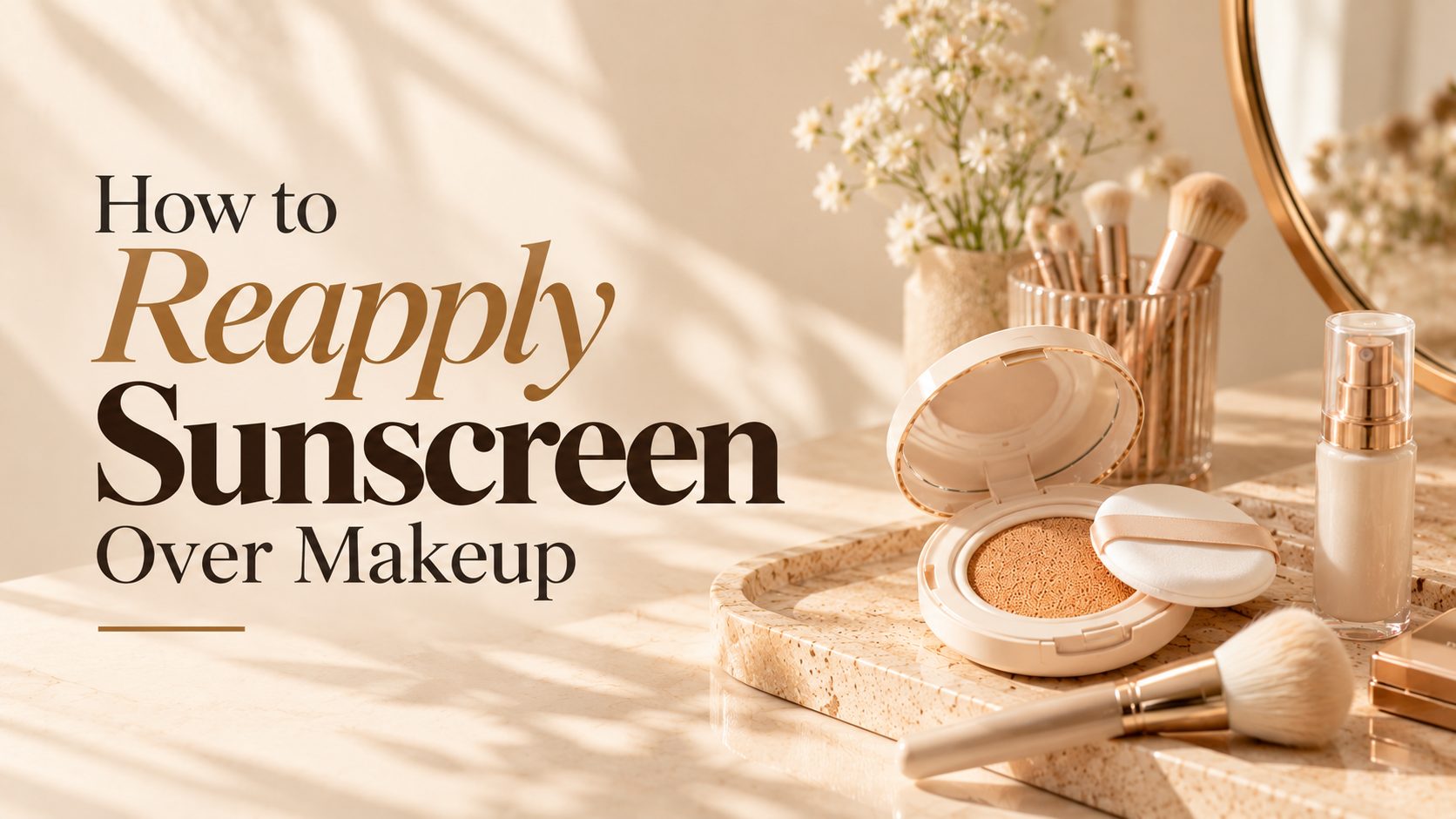
- Cushion spf compacts bring together spf and light coverage in one go.
- The SPF stick is suitable for the nose, cheeks, and forehead.
- Gel fluids that are lightweight get absorbed easily and give a skin-like finish.
- Setting mists with SPF can offer additional coverage, but use them only as an added layer and not your primary one.
Look for labels like “oil-free,” “matte finish,” or “non-comedogenic” to keep things from feeling heavy.
How to Reapply Sunscreen Over Makeup Step by Step
Knowing how to reapply sunscreen over makeup comes down to a gentle, layered approach. You’re topping up protection, not redoing your face.
- Blot first. Press a blotting paper or clean tissue on oily areas to lift excess oil and sweat.
- Choose your format. Use a spray, stick, cushion, or lightweight fluid.
- Apply in thin layers. Build up coverage gradually instead of applying one thick layer.
- Press, don’t rub. Pat with clean fingertips or a sponge so makeup doesn’t lift or streak.
- Don’t forget the edges. Cover the ears, hairline, jawline, and neck.
- Let it settle. Give it a minute to dry before touching your face.
- Set if needed. Dust a light, translucent powder over shiny areas.
If you’re using a spray, mist it onto a sponge or your palms first if you’re worried about disturbing your base.
Sunscreen Over Makeup Without Greasy Skin: Pro Tips
Before your makeup even gets to be applied, it’s important to get your sunscreen on without your skin turning greasy. This begins with a good base.
- Use a light moisturizer for preparation. Dry skin tends to produce excess oils that will later become visible as shiny skin.
- Apply a mattifying primer to any part of your face which tends to become oily.
- Pick matte or oil-free SPF formulas for both morning and midday use.
- Use thin layers. Thin layers of sunscreen dry fast and also give you a light coverage.
- Be gentle. Rough handling will lead to mixing of sunscreen with the foundation, hence creating an oily appearance.
Sunscreen Powder for Reapplication: Is It Enough?
Sunscreen powder for reapplication is popular because it’s convenient and mattifying. You brush it on, shine disappears, and your makeup stays put.
The catch is the amount. To get the SPF listed on the label, you’d need to apply far more powder than most people actually use, and a quick dusting gives only a fraction of that protection.
What that means in practice:
- Good for: touch-ups, controlling shine, and adding extra coverage on top of other SPF
- Not enough for: being your only source of reapplication during long outdoor days
- Works best: paired with a spray, stick, or lightweight lotion first, then powder on top
Think of sunscreen powder for reapplication as a helpful finishing layer instead of a complete replacement.
Common Mistakes When Reapplying Sunscreen Over Makeup
Even with the right products, a few habits can make reapplication messy or less effective.
- Rubbing it in. This lifts foundation and creates streaks.
- Using too little. Applying a tiny amount to avoid greasiness leaves you under-protected.
- Skipping blotting. Putting product over sweat and oil is what causes the slick, heavy feeling.
- Relying on SPF makeup alone. Foundation or powder with SPF rarely delivers the full labeled protection on its own.
- Forgetting to reapply on cloudy or indoor days. UV still comes through clouds and windows.
- Not matching textures. A rich cream over powder foundation often pills or separates.
Fixing these habits makes it much easier to reapply sunscreen over makeup without wrecking your look or your skin’s finish.
Frequently Asked Question
1. How do you reapply sunscreen over makeup?
Blot oil and sweat off your face first, then apply a lightweight sunscreen in thin layers. A spray, stick, or cushion compact works best because you can pat it on without dragging your foundation around. Let it dry for a minute, then dust on a little translucent powder if you look shiny.
2. How often should you reapply sunscreen over makeup?
Reapply about every two hours when you’re outdoors, and right after swimming or heavy sweating. If you’re mostly indoors, a midday top-up is still a good idea, especially if you sit near a window or commute in daylight.
3. Can you use regular sunscreen over makeup?
You can, but thick lotions and creams tend to smear foundation and leave a greasy film. If you only have a regular lotion, blot first, use a small amount, and press it in with a clean sponge. Lightweight formulas made for reapplication are easier to work with.
4. What is the best sunscreen to wear over makeup?
The best sunscreen to wear over makeup is lightweight, fast-drying, and doesn’t need rubbing in. Sprays, SPF sticks, cushion compacts, and gel fluids all work well. Look for labels like oil-free, matte finish, or non-comedogenic, and check that it’s broad-spectrum with SPF 30 or higher.
5. Is sunscreen spray good over makeup?
Yes, sunscreen spray over makeup is one of the easiest options because you don’t have to touch your face. Hold the bottle at the distance listed on the label, spray in light passes, and let it dry without rubbing. If you’re worried about disturbing your base, spray it onto your palms or a sponge first and pat it on.
6. How do you reapply sunscreen over makeup without making your skin greasy?
Start by blotting away oil and sweat so the new layer isn’t sliding over a slick surface. Use thin layers of an oil-free or matte formula, press instead of rubbing, and finish with a light dusting of translucent powder. Most greasiness comes from too much product or the wrong texture, not from reapplying itself.
7. Is sunscreen powder enough for reapplication?
Usually not on its own. To reach the SPF on the label, you’d need to apply far more powder than most people do, and a quick dusting gives only a fraction of that protection. It’s great for controlling shine and adding a bit of extra coverage, but it works best layered over a spray, stick, or lightweight lotion.
8. Does makeup with SPF replace sunscreen?
No. Foundation and powder with SPF are applied in much thinner layers than the amount of sunscreen needed to get the labeled protection. Treat SPF makeup as a bonus, and wear a proper sunscreen underneath it.
9. Does setting spray replace sunscreen?
No. Setting sprays hold your makeup in place, and even the ones that mention SPF aren’t designed to be your main protection. Use them as an extra layer on top of real sunscreen, not as a substitute.
10. Do you need to reapply sunscreen on cloudy days or indoors?
Yes, in most cases. UVA rays pass through clouds and through windows, so you can still get sun exposure on an overcast day, during a commute, or at a desk near the glass. If you’re staying fully indoors away from windows, you can skip the midday top-up.