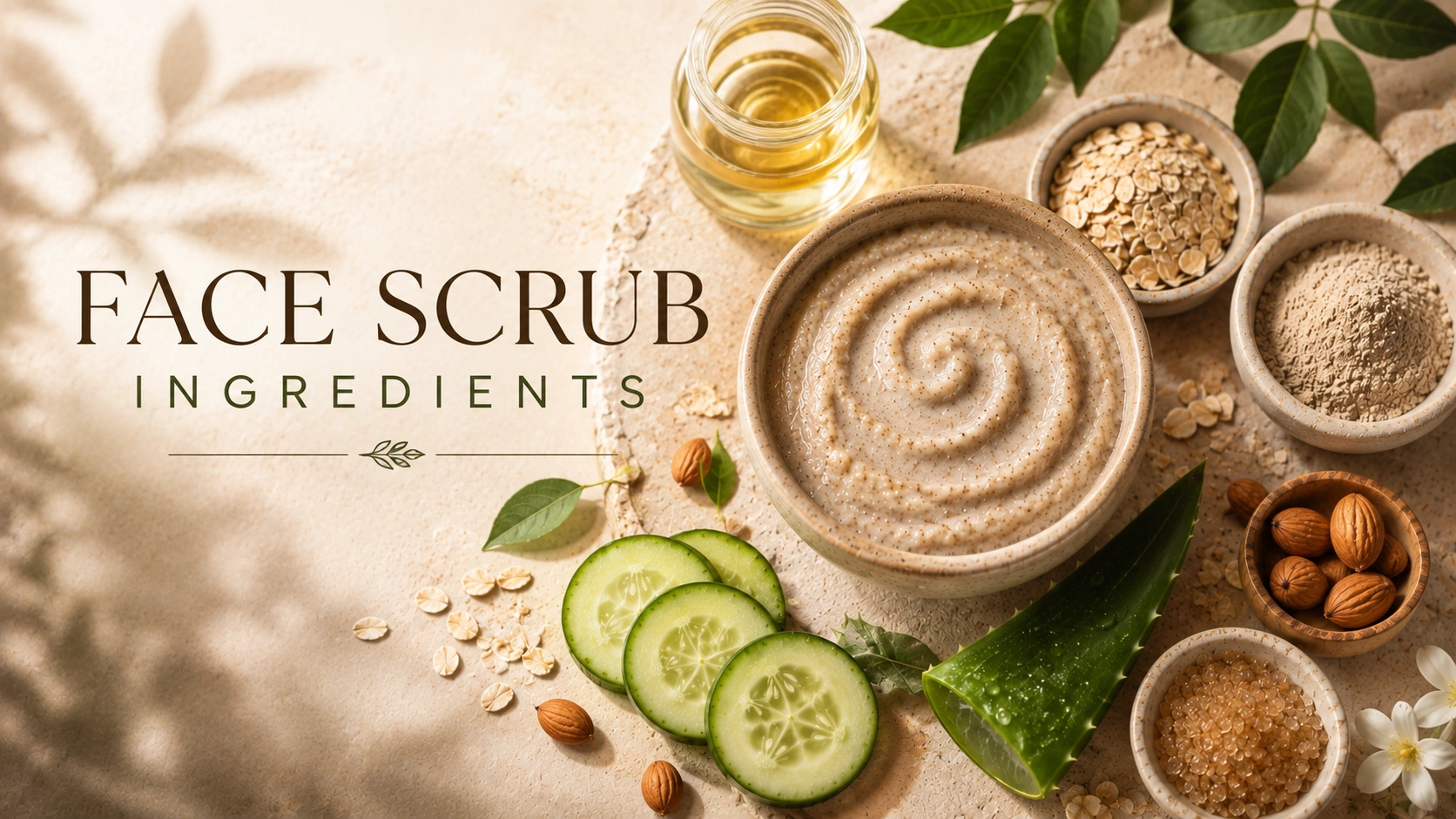
Most people judge a face scrub by how it feels. Gritty and rough gets read as "working." Smooth gets dismissed as weak. But that's the wrong way to pick one. What actually matters is the face scrub ingredients doing the exfoliating, not how much you can feel them.
The best face scrub ingredients combine a gentle exfoliant, like fine rice powder or jojoba beads, with calming actives such as aloe vera or centella asiatica. Not just abrasive particles scrubbing away at your face. A scrub built only for grit tends to do more damage than good, no matter how clean your skin feels right after.
This guide breaks down what's actually in a good face scrub, the exfoliating ingredients themselves, natural options worth choosing, picks for sensitive skin, and the ingredients you're better off avoiding entirely. By the end, you'll judge a scrub by its ingredient list, not by how much it scratches on the way down.
What Are Exfoliating Ingredients?
Exfoliating ingredients remove dead skin cells. That's it, at the core. Some do it by physically scrubbing them off. Others dissolve the glue holding them together. Every face scrub uses one method, or sometimes both.
Physical Exfoliating Ingredients — Grains, Beads, Powders
These work through friction. You rub them across your skin, they knock dead cells loose. Rice powder, jojoba beads, finely milled oats, all physical exfoliants.
Here's what actually matters, though: not the ingredient, the shape. Round and fine, it's gentle. Jagged, like crushed walnut shell, and it's basically sandpaper on your face.
Chemical Exfoliating Ingredients — AHAs, BHAs, PHAs
No scrubbing here. These loosen dead skin so it sheds on its own. AHAs — glycolic, lactic acid work on the surface. BHAs, like salicylic acid, get into pores. PHAs are the gentlest of the three, usually the safest bet if your skin reacts to the other two.
How to Tell Which Type Your Scrub Is Using
Skip the guessing. Check the label. Feel grains or beads? Physical. See "-ic acid" on the ingredient list with nothing gritty in the texture? Chemical. Plenty of scrubs use both, so read the whole list — don't judge it by how it feels in your hand.
Natural Exfoliants Worth Looking For
"Natural" doesn't automatically mean gentle. Some natural ingredients earn their spot in a scrub. Others just sound good on a label. Here's what's actually worth looking for.
Rice Powder — Fine, Gentle, Suits Most Skin Types
Rice powder is about as gentle as physical exfoliation gets. The particles are naturally fine and round, so there's no scratching, no micro-tears. Works across oily, dry, combination, even sensitive skin.
Mulberry Extract — Brightens While Skin Exfoliates
Mulberry extract isn't there to scrub. It's there to work alongside exfoliation, helping fade dullness and even out tone as dead skin cells clear away. Pairing an extract like this with a gentle exfoliant means you're not just removing buildup, you're actively brightening while you do it.
Green Tea Extract — Antioxidant Support During Exfoliation
Exfoliation puts a bit of stress on skin, even the gentle kind. Green tea extract helps offset that. It's rich in antioxidants, which means it protects skin from everyday environmental damage while calming any redness that shows up right after scrubbing.
Not All "Natural" Exfoliants Are Gentle
Walnut shell and apricot kernel get marketed as natural, but natural doesn't mean smooth. Under a microscope, both are jagged, not round. They tear at skin instead of gently lifting dead cells off. If a scrub leans on "natural" as its main selling point, check what the actual particle is — the word alone tells you nothing about how it feels on your face.
Skincare Ingredients That Support Exfoliation
Exfoliation on its own can leave skin a little stressed. That's normal. What matters is what's in the formula to offset it. These ingredients don't exfoliate — they make exfoliation safer.
Aloe Vera — Hydration and Calming Alongside Exfoliation
Aloe does two things well. It hydrates, and it calms. Right after exfoliating, skin needs both. A scrub with aloe built in means you're not left tight or irritated the second you rinse it off.
Niacinamide — Brightening and Barrier Support Post-Exfoliation
Niacinamide isn't exfoliating either. Its job comes right after — supporting the skin barrier so it recovers properly, while also brightening tone over time. Pairing it with an exfoliant means your skin isn't just clear, it's also more even.
None of these ingredients replace the exfoliant itself. They're there so exfoliation doesn't come at a cost — smoother skin without the redness, tightness, or irritation that a scrub alone can sometimes cause.
Best Ingredients for a Gentle Face Scrub
Gentle doesn't mean weaker. It means the ingredient does its job without damaging skin in the process. Here's what actually makes a scrub gentle.
Fine, Uniform Particle Size — Texture Matters More Than Material
The material gets all the attention, but shape matters more. Fine, round, evenly sized particles exfoliate smoothly. Large or irregular ones — even from a "natural" source — scratch instead of scrub. Size and shape decide gentle or harsh, not whether it's natural or synthetic.
Mild Chemical Exfoliants — Lactic Acid, PHAs
If physical particles keep irritating your skin, chemical exfoliants are the alternative worth trying. Lactic acid is milder than glycolic acid and adds some hydration on top. PHAs are gentler still, usually the safest starting point for skin that reacts to almost everything else.
Ingredients That Reduce Friction During Use
Glycerin and lightweight oils in a scrub's base help the particles glide instead of drag. Less friction means less irritation, even with a physical exfoliant. It's a small detail most people never think about, but it changes how a scrub actually feels on skin.
Quick reference — gentle vs harsh ingredients:
Face Scrub Ingredients for Sensitive Skin
Sensitive skin doesn't need to avoid exfoliation altogether. It just needs a formula that's actually built for it, not one that happens to work sometimes.
What Sensitive Skin Needs
Two things matter most: soothing actives in the formula, and minimal to no fragrance. Fragrance is one of the most common irritants in skincare, and sensitive skin reacts to it faster than most. A scrub without soothing ingredients backing up the exfoliant is asking for trouble, no matter how mild the particles are.
Ingredients to Patch-Test Carefully or Avoid
Essential oils, added fragrance, and any jagged physical exfoliant like walnut shell should get a patch test at minimum, and ideally skipped altogether. Higher-percentage acids fall into the same category. None of these are automatically bad for everyone, but sensitive skin has a lower margin for error, so it's not worth the risk without testing first.
Face Scrub Ingredients to Avoid
Not every exfoliating ingredient deserves a place in your routine. A few show up often enough that they're worth calling out specifically.
Walnut Shell and Apricot Kernel
These get marketed as natural, gentle options, but they're neither. Under a microscope, the particles are jagged, not round. They create micro-tears in skin rather than smoothly lifting dead cells off, and repeated use adds up over time.
Added Synthetic Fragrance
Fragrance is one of the most common irritants in skincare, full stop. It adds nothing functional to a scrub, and for a product that's already working the skin's surface, an added irritant is the last thing you need.
High-Percentage Acids in a Rinse-Off Product
Strong acids can work, but not in something you rinse off in under a minute. High-percentage glycolic or salicylic acid in a scrub is often just there for the label, without enough contact time to justify the irritation risk it carries.
Frequently Asked Questions
1. What ingredients should I look for in a face scrub?
Look for a gentle exfoliant with fine, uniform particles like rice powder or jojoba beads, paired with calming ingredients such as aloe vera, centella asiatica, or green tea extract.
2. Are natural exfoliants better than chemical ones?
Not automatically. Natural doesn't mean gentle — walnut shell and apricot kernel are natural but jagged and irritating, while mild chemical exfoliants like PHAs or lactic acid can be gentler than many natural options.
3. What face scrub ingredients are best for sensitive skin?
Oat, centella asiatica, aloe vera, and fine rice powder are among the best-tolerated ingredients for sensitive skin, since they exfoliate gently while calming the skin at the same time.
4. What ingredients should I avoid in a face scrub?
Avoid walnut shell, apricot kernel, added synthetic fragrance, and high-percentage acids, since these commonly cause irritation, micro-tears, or excessive dryness.
5. Can face scrub ingredients cause breakouts?
Yes, if the formula uses harsh, jagged particles or added fragrance, it can irritate skin and trigger breakouts. Gentle exfoliants paired with soothing ingredients are less likely to cause this.
6. Is mulberry extract good for skin?
Yes. Mulberry extract helps brighten skin and even out tone, making it a useful addition to a face scrub alongside a gentle exfoliant.
7. What does green tea extract do in a face scrub?
Green tea extract provides antioxidant protection and helps calm redness, offsetting some of the mild stress exfoliation can put on skin.
8. Is niacinamide useful in a face scrub?
Yes. While niacinamide doesn't exfoliate, it supports the skin barrier and brightens tone after exfoliation, making recovery smoother.
9. What's the difference between physical and chemical exfoliating ingredients?
Physical exfoliating ingredients, like grains or beads, remove dead skin through manual friction. Chemical exfoliating ingredients, like AHAs, BHAs, and PHAs, dissolve the bonds holding dead skin cells together without any scrubbing.
10. Do face scrub ingredients expire or lose effectiveness over time?
Yes, most active ingredients degrade over time, especially antioxidants like green tea extract and acids like lactic acid. Using a scrub within its shelf life ensures the ingredients still work as intended.